ANDE In Action

ANDE empowers adult learners by demonstrating how math plays a vital role in everyday life, enabling them to acquire essential skills for the GED and workforce. It’s not only the students who receive support. ANDE equips instructors with tailored guidance and professional development, ensuring they can lead engaging mathematical discussions and execute the curriculum effectively in diverse adult education environments. 

ANDE promotes rich mathematics discourse

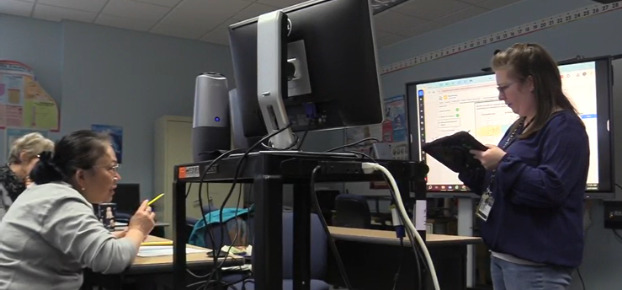
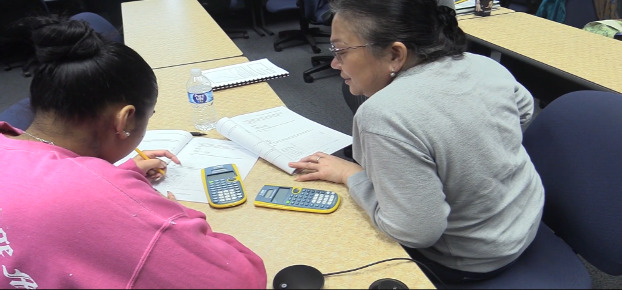
Three conditions make ANDE’s classrooms work—and program leaders can help put each in place: focused mini-courses with managed enrollment, purposefully sequenced content that builds toward meaningful reasoning, and sustained professional development that transforms teaching practice. ANDE moves beyond traditional one-to-one tutoring by equipping instructors to lead whole-class discussion, launch collaborative routines, and make student thinking visible. With the right support, instructors can shift toward ambitious, discourse-rich adult numeracy instruction.

ANDE instructor quote: “ANDE changes the way I teach the course because we see math in a more friendly perspective. Everybody hates math when they come into the GED class. I think this changes their perceptions because they see these are some of the things they do in their lives every day.”
How has ANDE been different?

ANDE supports student math achievement

Adult learners notice—and value—the instructional practices that support their learning. Even when challenged to explain their thinking or work through productive struggle, they recognize the purpose and embrace the experience. ANDE’s Cultivating Inclusive & Resilient Communities of Learners (CIRCL) Supports help create the confidence, belonging, and collaborative culture that makes mathematics learning possible. Most importantly, learners’ voices show that discourse-rich classrooms do more than strengthen mathematical reasoning—they build confidence and empower students as active members of a learning community.
ANDE student quotes: “She would walk me through and I always do that, you know, if I think my figure is right… she always walked me through it and tell me, ‘Well Pam, yours is wrong, or you, theirs is wrong.’”

“She would…have icebreakers in the beginning of the class…that’s like to get any nerves out”

In an ANDE Classroom

Discussing Math

Working Together

ANDE is flexible

ANDE is designed for online, in-person, and hybrid learning, giving adult learners the flexibility to learn around work, caregiving, and transportation demands. Across every modality, the experience remains consistent: learners engage in rich mathematical discourse, compare strategies, explain their reasoning, and learn from one another. The format may change, but the focus on meaningful, collaborative learning does not.

In this fully remote ANDE class, Kim, the teacher, engages her students in the Comparing Solved Problem signature routine to make sense of double number lines.

In this hybrid ANDE class, Lauren, the teacher, engages her students in the Which one doesn’t belong? Signature routine as they begin to study ratios.

ANDE instructor quote: “I think ANDE is completely different in the concept of working together to solve something. And that you can actually have a conversation and dialogue to solve a problem, not just ‘know what three times five is’, like the weird, ‘either I know it or don't’. And the math brain thing [learned during the ANDE PD] is once again revolutionary.”

ANDE instructor quote: “When facilitating remote instruction, creating active movement or managing high-flex environments presents unique challenges. In these settings, educators must provide intentional wait time to foster reflection—allowing students time to formulate ideas and engage in think-pair-share routines before contributing to whole-class discussion.” 

ANDE community supportive of students and brings back the joy in math

Belonging matters. Adult learners described classrooms where respectful discussion, collaboration, and even laughter created a safe space to take risks and learn from one another. They recognized that instructors intentionally build this sense of community through shared norms, thoughtful facilitation, and opportunities for every learner to contribute—creating classrooms where students feel known, supported, and ready to engage.
ANDE student quotes:
“Nobody is shaming anybody about anything or being rude.”
“I feel like we’re all as one. We’re trying to accomplish the same thing here.”
“If you’re listening to different inputs from different people, it all helps.”
“People are laughing and coming…they’re engaging…they’re more focused on my learning.” 

Explore ANDE

Explore the ANDE mini-courses and request an instructor account to access all ANDE materials.